Not all traders in the report are of equal importance. In fact, of the three types of traders, investors usually pay attention to the one type with requirements most like the individual trader.
1. Commercial Traders: These traders represent companies and institutions who use the futures market to offset risk in the cash or spot market. For example, a corn producer may short corn futures contracts to protect her profits if prices fall in the near term. This class of trader is not going to be very helpful for retail investors and we don’t pay much attention to them.
2. Non-Commercial Traders: This category includes large institutional investors, hedge funds and other entities that are trading in the futures market for investment and growth. They are typically not involved directly in the production, distribution or management of the underlying commodities or assets. We pay the most attention to this category.
3. Non-Reporting Traders: This is the catch-all category for traders too small to be required to report their positions to the CFTC. We don’t know how many individual traders there are or what kind of investors they represent because they are non-reporting. Most market professionals assume that a major percentage of this category are individual speculators. They are notoriously bad traders and you will more often see this category betting against the trend than with it. We don’t pay any attention to this category.
Knowing what the big traders (non-commercials) are doing through the COT report gives us some idea about the trend for a particular asset class. We can use these reports to see what the big money is doing in just about any asset class. There are COT reports for equity investors (stock futures), commodity traders (including oil and gold) and currency traders (very important for spot
Using the COT Report In using the COT report, commercial positioning is less relevant than noncommercial positioning because the majority of commercial currency trading is done in the spot currency market, so any commercial futures positions are highly unlikely to give an accurate representation of real market positioning. Noncommercial data, on the other hand, is more reliable as it captures traders' positions in a specific market. There are three primary premises on which to base trading with the COT data:
- Flips in market positioning may be accurate trending indicators.
- Extreme positioning in the currency futures market has historically been accurate in identifying important market reversals.
- Changes in open interest can be used to determine strength of trend.
Flips in Market Positioning Before looking at the chart shown in Figure 2, we should mention that in the futures market all foreign currency exchange futures use the U.S. dollar as the base currency. For Figure 2, this means that net-short open interest in the futures market for Swiss francs (CHF) shows bullish sentiment for USD/CHF. In other words, the futures market for CHF represents futures for CHF/USD, on which long and short positions will be the exact opposite of long and short positions on USD/CHF. For this reason, the axis on the left shows negative numbers above the center line and positive numbers below it.
The chart below shows that trends of noncommercial futures traders tend to follow the trends very well for CHF. In fact, a study by the Federal Reserve shows that using open interest in CHF futures will allow the trader to correctly guess the direction of USD/CHF 73% of the time.
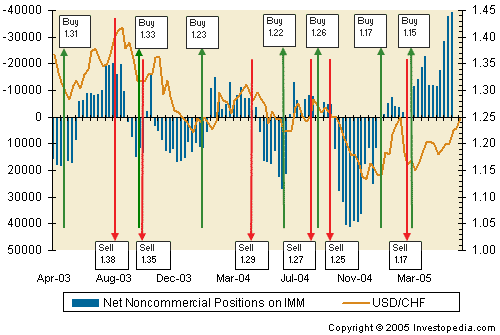 Figure 2: Net positions of noncommercial traders in the futures for Swiss francs (corresponding axis is on the left-hand side) on the International Monetary Market (IMM) and price action of USD/CHF from April 2003 to May 2005 (corresponding axis is on the right-hand side). Each bar represents one week. Source: Daily FX. |
Flips - where net noncommercial open-interest positions cross the zero line - offer a particularly good way to use COT data for Swiss futures. Keeping important notation conventions in mind (that is, knowing which currency in a pair is the base currency), we see that when net futures positions flip above the line, price action tends to climb and vice versa.
In Figure 2, we see that noncommercial traders flip from net long to net short Swiss francs (and long dollars) in June 2003, coinciding with a break higher in USD/CHF. The next flip occurs in September 2003, when noncommercial traders become net long once again. Using only this data, we could have potentially traded a 700-pip gain in four months (the buy at 1.31 and the sell at 1.38). On the chart we continue to see various buy and sell signals, represented by points at which green (buy) and red (sell) arrows cross the price line.
Even though this strategy of relying on flips clearly works well for USD/CHF, the flip may not be a perfect indicator for all currency pairs. Each currency pair has different characteristics, especially the high-yielding ones, which rarely see flips since most positioning tends to be net long for extended periods as speculators take interest-earning positions.

Không có nhận xét nào:
Đăng nhận xét